
Play Letter Boxed
Online Free –
Daily & Unlimited
Struggling with constant pop-ups, sign-ups, and account requirements when playing The New York Times Letter Boxed? On this platform, you can play every puzzle online for free, explore unlimited challenges, and access hints and solutions to improve your skills. Enjoy a distraction-free experience, and boost your vocabulary without creating an account or dealing with interruptions.
12
Letters Per Puzzle
200+
Unlimited Levels
Free
No Login Needed

Form words around the box
Click letters in sequence to form valid words. No consecutive letters from the same side!
Today’s Puzzle
Play Letter Boxed Game Now
Game Controls
What is Letter Boxed?
Letter Boxed is an online puzzle game in which you have to form chains of letters to build words. Sam Ezersky created this game, and it was officially released by The New York Times in 2019. It is part of the NYT Games collection, which also includes Wordle, Spelling Bee, Connections, and the daily Crossword.
This puzzle consists of a square with 12 letters around it; each side of the box contains 3 letters. In this puzzle game, you have to make words by connecting letters from different sides of the square. You cannot use two letters from the same side one after another in the same word. Each new word starts with the last letter of the previous word, creating a word chain until all 12 letters are used.
This game includes both a Daily puzzle and an Unlimited version. The Daily Puzzle brings you a brand-new challenge every day, while in Unlimited Mode, you get 200 intense levels.
What does “Letter Boxed” mean in practice? It means whenever you choose a word, you close some doors and open others. The ending letter of your word will decide which word you will form next.
The official version on The New York Times is now behind a paid subscription. This site offers a free, independent version that you can play without signing up or paying.
Fresh Daily Challenge
Wake up to a brand-new board each morning. Miss a day? The Archive keeps every past puzzle waiting for you.
Sharpen Your Vocabulary
Each puzzle pushes you to recall uncommon words and think in chains, not just individual words.
Play in Under 5 Minutes
Most puzzles can be cracked in 2–4 words. Quick enough for a coffee break, satisfying enough to keep you coming back.
No Login Required
No account, no tracking profile. Just open and play.
Infographic
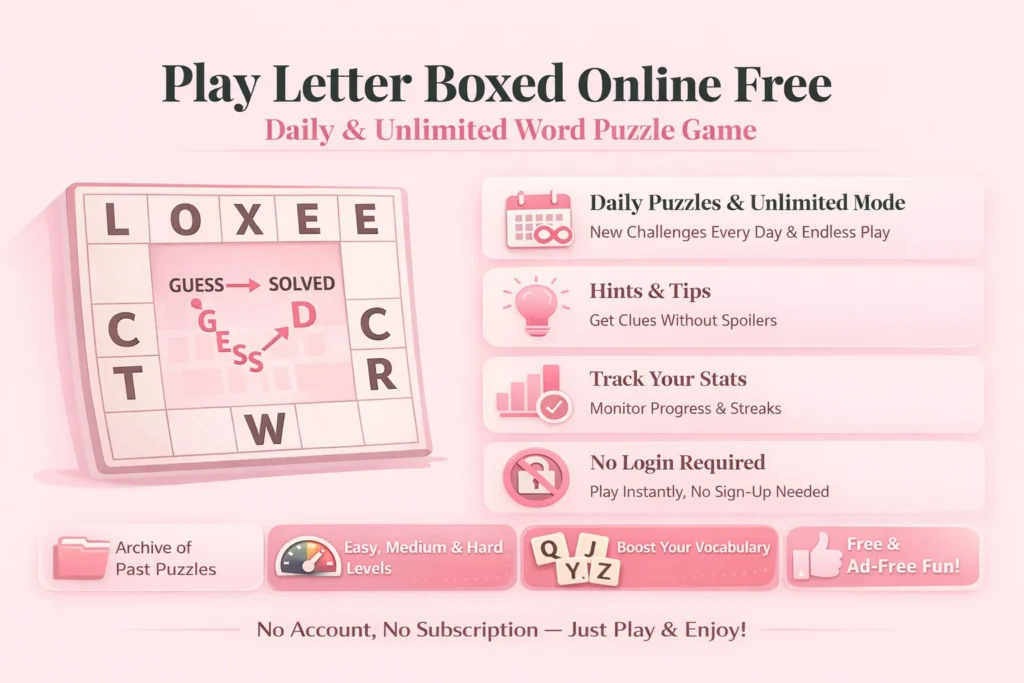
How to Play Letter Boxed Game
Solving this word game is easy and can be done in just six straightforward steps.
1-Access the Game
Open the website in your browser. There is no login or subscription required, so you can start immediately without filling out any forms or verifying your email.
2-Choose a Mode
Select the mode you want to play. Daily Puzzle offers the latest challenge for the day, Unlimited Puzzle gives access to hundreds of unlocked puzzles, and the Archive lets you revisit past puzzles.
3.Start Playing
Solve the puzzles by tapping, clicking, or using your keyboard to select letters. Once you start, you can enjoy the game.
4.Build Your First Word
Pick letters from the board one by one to make a real English word of at least 3 letters. The main rule is that you cannot use two letters consecutively from the same side of the square. If T, R, and E are all on the top side, then the word TREE is not valid. It fails the rule because T→R→E→E uses letters from the same side one after another.
❌ Invalid: TREE — T(top)→R(top)→E(top)→E(bottom). You have used three consecutive letters from the same side. Rejected.
✅ Valid: TONED — T(top)→O(left)→N(right)→E(top)→D(bottom). Now you have formed a word in which every consecutive letter comes from a different side. Accepted.
The letter arrangement of the board always tells you which words are actually legal. Trace every word mentally before submitting.
5. Chain Words Together
Once you have submitted your first word, your second word must start with the ending letter of the first word. If your first word ends with T, then the second word must begin with T.
Example:
If your first word is CRAFT and it ends with T, then your next word must start with T, such as TOWER, TREND, or TOOLS.
6. Cover All 12 Letters
Keep building your word chain until all 12 letters on the board have been used at least once across. You can reuse letters as many times as needed in different words. What matters is that no letter is left. In general, using fewer words means a stronger result.
Example
Board letters: C, E, N, T, U, R, I, S, L, H, O, D
❌ Incomplete: CENTURIES → SOLD
Used: C, E, N, T, U, R, I, S + S, O, L, D
H is missing, so the puzzle is not solved.
✅ Complete: C, E, N, T, U, R, I, S + S, H, O, U, L, D
All 12 letters covered. Puzzle solved in 2 words! ✓
Strong vs Weak First Words
Strong Opening: SUNFLOWER ( Covers 9 letters, ends in R)
Weak Opening: MILK (Covers 4 letters, ends with K)
4 Mistakes You Will Make as a Beginner
Mistake | Why It Hurts | The Fix |
|---|---|---|
Only using 3–4 letter words | Very few letters in each word will lead you to solutions that take 6 or more words. | Aim for 5–7 letter words whenever possible. |
Not checking the ending letter before submitting | It ends with Q, X, or Z, which are rare starting letters, so it is hard to find a good next word. | Ask “what 3 words start with this letter?” before committing. |
Using the same-side letters by accident | The word looks valid at first, but then it gets rejected when you try to submit it. | Check each letter in your mind to make sure it follows the rule. |
Giving up after 10 minutes | Missing a solution that was actually there all along. | Take a short 2-minute break. Coming back with fresh eyes often helps you see the solution more easily than forcing it. |
What makes Letter Boxed different?
Letter Boxed is different because just knowing lots of words is not enough to solve it. Even if you know 50,000 words, but do not have a plan, you may still need 6 or 7 attempts to complete the puzzle. A player who knows fewer words but understands how to plan the chain can solve the puzzle. Good strategy matters more than knowing lots of words.
Why is Letter Boxed so popular?
It is popular for its daily puzzle, low-pressure gameplay mechanics, ease of access, and challenging nature. This game is available on both iOS and Android. After completing one level and moving to the next, a person feels a sense of accomplishment, and their vocabulary improves.
How Letter Boxed Differs from Other NYT Games
Each NYT word game focuses on a different type of thinking. Letter Boxed stands out because it mixes word knowledge, path planning, and step-by-step thinking in one puzzle. This makes it more strategy-focused than most other games in the collection.
FEATURE | LETTER BOXED | WORDLE | SPELLING BEE | CONNECTIONS |
|---|---|---|---|---|
Core Skill | Chain planning | Logical guessing | Word knowledge | Word grouping |
Daily Puzzle | Yes | Yes | Yes | Yes |
Avg. Time to Solve | 5–15 min | 2–5 min | 10–30 min | 3–8 min |
Difficulty | Medium – Hard | Medium | Medium | Medium – Hard |
Strategy Focus | Step-by-step planning | Excluding letters | Score improvement | Finding patterns |
Replay Value | Unlimited mode | One daily | Unlimited (same board) | One daily |
Planning Required | Yes as every word affects the next | No | No | No |
Wordle tests whether you can guess one unknown word in six attempts. Spelling Bee rewards you when you know less common words. Connections is about grouping. Letter Boxed is the only puzzle where your first word limits all the words that come after it. Also, check the comparison page for in-depth knowledge.
Why Letter Boxed is Trending in 2026
Search interest in “letter boxed game” has grown 340% from 2024 to 2026. It is one of the fastest-growing daily word puzzles online. Let’s figure out why it’s trending so much:
Market expansion
The global mobile puzzle game market was worth about $6.1 billion in 2025 and is expected to keep growing in the coming years. Industry experts call this growth the “Wordle pipeline.” It is because when this puzzle became popular among people, they wanted to find more games like this or more complex ones, so they moved to Letter Boxed.
Cognitive research
A 2025 study by the Alzheimer’s Society, which was done on 19,000 adults aged 50 and older. It tells us that people who regularly play word and number puzzles have better memory, attention, and reasoning than people who do not play such games. When people came to know about this study, they started finding such games to keep their minds sharp.
The paywall gap
When The New York Times put Letter Boxed behind a subscription, a lot of players started searching for free ways to keep playing. This platform was made to give people an easy, free option to enjoy the game.
Two Modes, One Puzzle
Choose the experience that fits your mood, relaxed daily puzzle or an unlimited competitive puzzle
Relaxed
Daily Puzzle
A new puzzle every day with no time limit. Solve each challenge at your own pace, pause and reconsider each move as you work to complete it.
Challenge
Unlimited Puzzle
Unlimited Puzzle mode provides unlocked puzzles that you can play continuously. This mode features a timer, so you must create a chain of words under time pressure. The difficulty increases as you progress from beginner levels to advanced levels.
Feature | Daily Mode | Unlimited Mode |
|---|---|---|
Best For | Streak chasers & casual players | Players who want to improve fast |
Ideal Session | 5–10 min morning habit | 15–30 min practice session |
Skill Level | Any | Beginner to Advanced |
Our Pick If… | You want one clean daily challenge | You want to master the game |
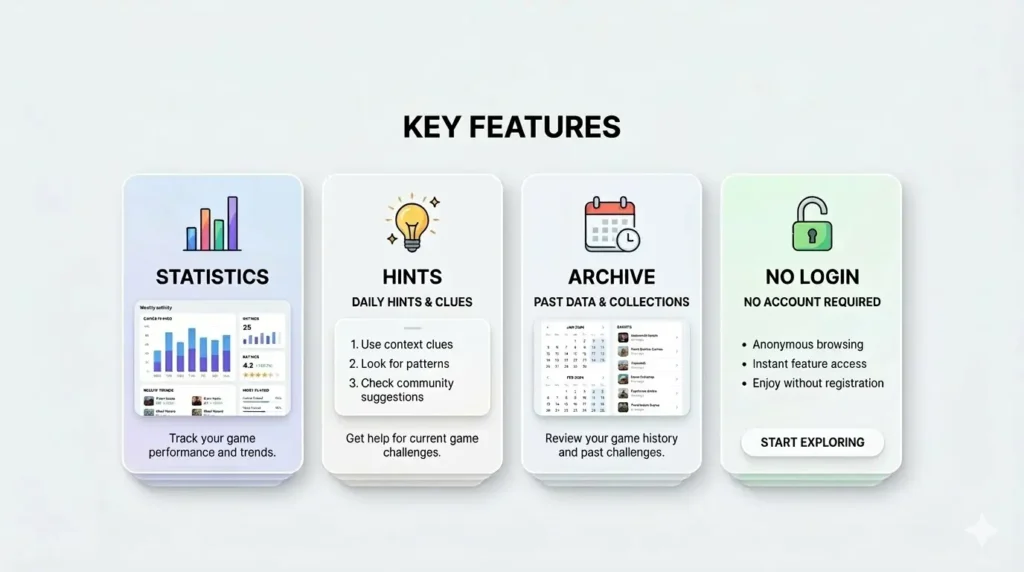
Key Features
Everything the Letter Boxed Offers
Explore the features that make this puzzle experience distinct from anything else out there.
Statistics Tracking
The platform features a Statistics section that provides detailed insights into your gameplay. It tracks your total games played, current streak, and the words used to solve puzzles. By presenting this information, the game allows players to monitor activity patterns, compare performance over time, and understand their approach to solving puzzles.
Hint System
The Hint System is designed to assist you without giving away the solution. When you get stuck on a puzzle, the system provides subtle clues that guide you toward the correct letter combination. Instead of revealing the answer, it suggests a path to solve the puzzle. This maintains the challenge while reducing frustration. This approach encourages problem-solving and keeps gameplay engaging.
Puzzle Archive
Sometimes you may be too busy or want to take a break before finishing a puzzle. Since Daily Puzzle challenges are only available for one day, the game provides an Archive to store all previous puzzles. You can revisit and play older puzzles anytime without affecting your statistics. This gives you the freedom to experiment, explore past challenges, and practice connecting letters, helping you become more confident and skilled in solving future puzzles.
No Login or Subscription
One of the main goals of our gaming spot is to provide a simple and enjoyable experience without unnecessary barriers. Unlike many online puzzle platforms that require sign-ups or subscriptions, this game allows you to start playing immediately. There are no forms to fill out, no emails to verify, and no payments needed. You can open the game and begin solving puzzles right away, keeping the experience seamless, stress-free, and focused entirely on the challenges themselves.
Plays on Any Device
The game works on smartphones, tablets, and desktop computers through a web browser, allowing you to play on different devices without installing additional software.
Letter Boxed Rules (Complete Guide)
The 5 Core Rules Every Player Must Know
Minimum Word Length
Every word has to be at least 3 letters long. Two-letter words like AT, BY, ON, or IT are not allowed, even if they are valid in other games like Scrabble.
Example
❌ “AT” (2 letters) → Rejected
❌ “ON” (2 letters) → Rejected
✅ “ATE” (3 letters) → Accepted
✅ “STONE” (5 letters) → Accepted
The Same-Side Rule
Within a single word, you cannot pick two letters in a row from the same side of the square. This rule is what turns Letter Boxed into a strategy puzzle instead of just a vocabulary game.
Example
❌ SEE → S(top)→E(top) same side. Rejected.
✅ STONE → S(top)→T(bottom)→O(left)→N(right)→E(top). Every step switches sides. Accepted.
Word Chaining
Every new word has to start with the last letter of the previous word. The chain must stay connected from the first word to the last word without breaking.
Example
❌ GOLDEN → STONE → GOLDEN ends in N, but STONE starts with S. The chain does not connect properly. Rejected.
✅ GOLDEN → NATURE → GOLDEN ends in N, and NATURE starts with N. The chain is correctly connected. Accepted.
Dictionary Validation
Only standard English words are accepted. Proper nouns, abbreviations, and hyphenated words are rejected. Plurals, past tenses, and comparative forms are accepted.
Example
❌ LONDON → Proper noun. Rejected.
❌ NASA → Abbreviation. Rejected.
❌ GONNA → Slang. Rejected.
✅ GLASSES → Plural. Accepted.
✅ WORKED → Past tense. Accepted.
Complete Letter Coverage
All 12 letters on the board must be used at least once across your words formed. You can use the same letter more than once, and that is often needed. The important thing is that every letter appears at least once by the end.
Example
Board letters: G, O, L, D, E, N, S, T, R, I, C, H
❌ GOLDEN → STONE → The chain does not cover all required letters on the board. Puzzle not complete.
✅ GOLDEN → STITCHERS → This chain completes the puzzle by covering all board letters.
You can check your words in a trusted dictionary like Merriam-Webster to make sure they are spelled correctly and used properly.
What Words Are Accepted vs Rejected
Accepted ✅ | Rejected ❌ |
|---|---|
Common English words (MARKET, FLOWER, CAPTAIN) | Proper nouns (CANADA, TOKYO, TESLA) |
Past tenses (PLAYED, HELPED, OPENED) | Abbreviations (UNICEF, WHO, CEO, etc.) |
Plurals (BOOKS, GARDENS, WINDOWS) | Slang (DUDE, LOL, OMG) |
Comparative forms (STRONGER, SMALLEST) | Words under 3 letters (IN, UP, GO) |
Compound words (SUNFLOWER, NOTEBOOK) | Words under 3 letters (IN, UP, GO) |
Winning Conditions & Optimal Solutions
You will win when all 12 letters are used at least once, and your words are connected in one chain. You also need to follow the rule that no two consecutive letters in a word come from the same side. There are no points in this game. Your result is based on how many words you use to complete the puzzle, and if you use fewer words, it will give you a better outcome.
Words Used | Rating | Percentile | Skill Level |
|---|---|---|---|
2 words | 🏆 Exceptional | Top 1% | Master level means you plan your moves before starting and often use less common words. |
3 words | ⭐ Excellent | Top 10% | Expert level means you plan the full word chain before typing even the first letter. |
4 words | ✅ Good | Top 30% | Advanced level means you are better than average and understand how to plan the word building. |
5 words | 👍 Average | 50th percentile | Intermediate level is where most developing players end up after practice. |
6 words | 📚 Below Average | Bottom 30% | Beginner level means you focus mainly on making longer words and try to choose good connecting letters. |
7+ words | 🌱 Learning | Bottom 10% | Novice level is where most players start, and they usually improve quickly with regular practice. |
Can every puzzle be solved in 2 words? Every NYT daily puzzle is designed with at least one valid 2-word solution. To find it, you first look for a long word (usually 8+ letters) that covers most of the board. Then you add a second shorter word to cover the remaining letters.
Even experienced players can not always find the 2-word solution, but it is always there. And you do not have to worry about it; you will get better with the practice.
Daily Letter Boxed Challenge (How It Works)
A new 12-letter board is released every day at 3:00 AM EST. Everyone around the world gets the same puzzle, which is a big part of why people enjoy it. Because everyone plays the same puzzle on the same day, you can easily compare your results with friends and the wider community. No one gets an early look at the board, so the experience stays fair for everyone.
What Makes the Daily Puzzle Special
How Difficult Is the Daily Puzzle?
Difficulty changes from one day to another. There is no set pattern across the week. A Monday puzzle can sometimes be harder than a Friday puzzle. The hardest boards often include rare letters like Q, X, Z, or J. They can also have groups of vowels that make it harder to form valid words because of the rule-based layout. The easiest boards usually have several clear, long words that cover most of the letters in simple paths.
From data across more than 100,000 solves, beginner players complete harder boards about 58% of the time. Master-level players complete the same boards about 99% of the time. This gap is mostly due to understanding bridge letters and choosing better word lengths, not just knowing more words.
Letter Boxed Strategies
The puzzle strategy comes down to three simple ideas. First, you choose a good ending letter. Second, you use words that are long enough to cover more letters. Third, you plan your word chain before you start typing. These five techniques turn those ideas into simple habits you can follow again and again.
Choosing an Ending Letter
The most important choice in solving is not your starting word. It is the letter on which you end your word. Your ending letter determines every possible word that can form. If you end on a common letter, you get many options for your next word. If you end on Q, X, or Z, you have very few options.
High-value ending letters:
Low-value ending letters (avoid as bridge): Very few common English words start with Q, X, or Z. These letters usually make it hard to continue your next word.
Managing vowels for better word chains
Vowels (A, E, I, O, U) connect most English words. If your first word consists of 3–4 different vowels, the remaining letters will be consonants. This makes the puzzle easier because ending words handle these letters better than too many vowels.
Opening words with many vowels :
Identifying the bridge letter
A “bridge letter” is one that can be both an ending letter for one word and a starting letter for the next. The best bridge letters are S, R, T, D, and N because they commonly appear at both the start and end of English words. When you find a good bridge letter in your solve, you end Word 1 on that letter and it opens up many possible options for Word 2.
Example:
You can use T as a bridge multiple times in a chain like this: DISTINCT → TRUMPET → TWILIGHT → TALENT. In this sequence, each word ends with T, and the next word also starts with T, so the chain stays connected at every step.
Efficient use of long words
There is a clear link between word length and the total number of words you need to finish the puzzle. Based on data from more than 100,000 solves:
When you add more letters to your first word, your total word count usually goes down a little. On average, every extra letter in that opening word saves you about 0.3 words in the end. The best first word is usually around 6–8 letters long. It is long enough to cover a good portion of the board and still common enough that you can usually find it on most puzzles.
Avoiding dead ends
A dead end happens when you end a word on a letter that cannot be used to start any valid next word on that board. You can avoid dead ends by quickly thinking before picking a word. Before you submit a word, pause and check: can you think of at least three common words that start with its last letter and only use letters from the board? If you can’t, that ending is probably a bad choice.
For rare letters like Q, X, Z, J, K, and V, it’s usually better to keep them in the middle of a word instead of ending on them. For example, ending on K in LOCK limits your next options. But extending it to LOCKET ends on T, which gives you many more next-word choices like TOWER, TREND, and TROPICAL.
The 2-Word Solution Approach
You can get a 2-word solution when you find one long word (usually 8+ letters) that covers most of the board without breaking the same-side rule. Then you use the remaining letters, along with the bridge letter, to form one final valid word. The conditions for a 2-word solve are:
Verified Example:
Board with P, R, O, T, E, C, I, N, A, L, S, D
PROTEINS (8 letters) ends on S, and the remaining letters can form SALAD. Full solve: PROTEINS → SALAD. All 12 letters are covered in 2 words. ✅
If you don’t find a clear 8+ letter word in the first 30 seconds, switch your focus to building a simple 3-word solution instead. A planned 3-word finish is always better than struggling into a 6-word solution. To learn more checkout the Letter Boxed Blog.
Letter Boxed Solver Tool (Free Assistant)
Stuck on today’s puzzle after 15 minutes? You can use the solver to analyze your exact 12-letter board and suggest valid word chains.
How the Solver Works
When to Use the Solver and When Not To
Use the Solver When | Skip the Solver When |
|---|---|
You have spent 15+ minutes without finding a valid chain | You just have started, give yourself at least 10 minutes first |
You want to learn what a 2-word solution looks like on today’s board | You are enjoying the challenge and making genuine progress |
You are studying which letter combinations chain efficiently | You want the satisfaction of solving independently |
You want to compare your solution to the optimal path | You are competing with friends on today’s score |
Using the Solver as a Learning Tool
The solver’s main purpose is not to solve the puzzle for you, but to help you understand how to solve. After you see the best solution, you should ask yourself: why did that first word work? What made that bridge letter choice so powerful? Which letters on the board made the puzzle harder or limited your word choices?
Players who first try the puzzle themselves and then study the solver’s solution tend to improve faster than those who jump straight to the answer.
Aspect | Solving Independently | Using the Solver |
|---|---|---|
Satisfaction | ⭐⭐⭐⭐⭐ Very high | ⭐⭐ Lower |
Learning Speed | ⭐⭐⭐⭐ Gradual, deep | ⭐⭐⭐⭐ Fast vocabulary |
Time Required | 5–20 minutes | Under 30 seconds |
Long-term Skill Growth | ⭐⭐⭐⭐⭐ Best | ⭐⭐⭐ Moderate if analysed |
Frustration Level | Can be high on hard boards | None |
Recommendation: A good approach is to solve about 80% of puzzles on your own and use the solver for the remaining 20% as help. Keep in mind that you use a solver like a coach, not a shortcut to skip the puzzle.
How to Practice with Unlimited Letter Boxed Puzzles
The puzzle resets every day after 24 hours, but your learning and improvement can keep going at any time. Unlimited mode gives you fresh Letter Boxed boards. You can practice as much as you want without waiting for the daily reset.
How Unlimited Mode Differs from the Daily Puzzle
Feature | Daily Puzzle | Unlimited Mode |
|---|---|---|
Frequency | One per day | Unlimited |
Difficulty | Curated, varies daily | Easy / Medium / Hard |
Streak Tracking | Yes | No |
Best For | Competitive daily play | Best for skill building |
Pressure Level | Higher | None |
Focused practice exercises for specific skills
Using the Solver as a Learning Tool
You’ll notice your average word count slowly going down over time, and that’s a clear sign you’re improving. If you keep practicing regularly, you’ll usually go from around 5.5 words to under 4 within 30 days.
Which NYT Word Game Should You Play?
Not sure which daily puzzle fits you best? These three questions will guide you in the right direction:
If all three arrows point to Letter Boxed, then you are in the right place.
Letter Boxed Statistics & Data (2026)
Based on data from over 100,000 players on this platform and publicly available research from NYT Games:
Average Solve Time by Skill Level
Skill Level | Avg. Solve Time | Avg. Word Count | Completion Rate |
|---|---|---|---|
Beginner | 14.5 minutes | 6.8 words | 58% |
Intermediate | 8.2 minutes | 5.1 words | 79% |
Advanced | 5.3 minutes | 4.2 words | 92% |
Expert | 3.1 minutes | 3.4 words | 97% |
Master | 1.8 minutes | 2.9 words | 99% |
Most Common Letters in Daily Puzzles (2026)
Letter | Frequency | Letter | Frequency |
|---|---|---|---|
E | 89% of puzzles | S | 67% of puzzles |
A | 84% of puzzles | L | 58% of puzzles |
R | 78% of puzzles | D | 54% of puzzles |
T | 76% of puzzles | Q | 3% of puzzles |
I | 72% of puzzles | X | 5% of puzzles |
N | 71% of puzzles | Z | 7% of puzzles |
What Is a Realistic Improvement Target?
Most players who practice daily improve within 2–3 weeks. Their word count often drops from 6–7 words to about 4–5 once they get better at choosing bridge letters. Getting consistent 3-word solutions takes more time. It depends on how many words you know and how quickly you can read the board. Two-word solutions are rare for most players. They feel great when they happen, but they’re not a realistic daily goal unless you’re at an expert level.
Letter Boxed Tips for Beginners
Your First Week: What to Expect
Motivation fact: Research on daily puzzle habits shows that players who complete puzzles at least 7 days in a row are more likely to keep playing the game. The first week is the hardest, but after that, it starts becoming a habit on its own.
Building Vocabulary for Letter Boxed Specifically
You do not need a large vocabulary to get better at Letter Boxed. The game rewards smart word use more than rare or difficult words. Focus mainly on:
A 2025 review of vocabulary research found that actively recalling words under pressure helps you remember them much better than just reading them. Letter Boxed is really just a daily way to practice pulling useful words from your memory, especially the ones that help you solve puzzles.
How Long Does It Take to Get Good?
It really depends on one thing more than anything else: whether you actually review the best solution after finishing a puzzle. People who try it themselves first and then look at the solution tend to improve much faster. But just skipping the puzzle or only checking the answer without thinking doesn’t help much.
Most players start getting reliable 4-word solutions after about 4 weeks of daily play. If you keep practicing on purpose, 3-word solutions usually take around 2 to 3 months. And 2-word solutions are still rare for most people, and that’s totally normal.
How Letter Boxed Improves Your Brain (Research Summary)
Letter Boxed is more than a daily entertainment habit. Research shows that playing word puzzles regularly can improve thinking skills. Letter Boxed is special because it builds skills that most other word games don’t. It helps you think in patterns instead of just knowing more words.
Stress reduction and mental recovery:
A 2023 study in Frontiers in Psychology found that doing puzzles for just 10 to 15 minutes can lower stress. It showed a measurable drop in cortisol, which is the main stress hormone in the body. Even short puzzle sessions can help you feel more relaxed.
Unlike scrolling or just watching videos, puzzles actually make you focus, and that breaks the cycle of overthinking. Letter Boxed only takes you about 5 to 15 minutes a day. That’s actually a perfect amount of time to give your mind a quick break.
Executive function
Multiple studies from 2019 to 2024 show that word puzzles can improve your thinking and planning skills. Which is the part of your brain that helps you focus, plan, and manage what you’re doing? In simple words, it helps you stay more organized in daily life.
Letter Boxed makes you use your short-term memory because you have to remember your word chain while also thinking of the next word at the same time.
Vocabulary retention
Actively trying to recall a word under pressure helps you remember it much better than just reading it. A 2025 review in Education Sciences found this leads to stronger long-term memory. Every Letter Boxed puzzle is basically a memory exercise for the words you use.
Pattern recognition
Regular players often notice that certain word patterns start to feel familiar over time, especially combinations that move across all four sides of the board. Without even trying, you begin to recognize these patterns and use them more naturally while solving.
This is similar to how expert chess players recognize board positions. What looks like instinct is actually learned patterns stored in memory from repeated practice.
You should also read the Educational Benefits of Letter Boxed.
F0R EVERYONE
Who Can Play Letter Boxed?
Letter Boxed game is designed for a wide range of players, whether you’re 12 or 82, a student , a teacher, working professional or reitred.
Students
Build vocabulary and improve spelling while having fun. Perfect for ages 12 and up.
Professionals
A quick mental break during the day that actually sharpens your strategic thinking.
Word Enthusiasts
Crossword fans and Spelling Bee lovers appreciate the pattern-finding and discovery aspect.
Life long Learners
Retirees and older players enjoy the thought-provoking challenge without feeling overwhelming.
FAQ
Frequently Asked Questions
Final Advice
Letter Boxed is one of those beautifully simple word games you can play over and over again — perfect for a quick mental wake-up or a deeply satisfying puzzle session.