• Letter boxed Strategy
Reverse Solving Letter Boxed: Building Word Chains Backwards
Instead of starting from zero, experienced players often start with the ending word and then work backward to build a clean 2-word solution.
Unlike Wordle, which accepts any valid English word, Letter Boxed has one strict rule: you cannot choose two words simultaneously from the same side of the box. This rule brings the reverse solving method of the Letter Boxed puzzle to life. In this method, you choose the closing word of the puzzle first, which is the hardest part of the game.
What Is Reverse Solving?
It is the method of chain-building in which you select the last (closing) word of the puzzle before the first word. Instead of asking yourself “what word should I start with?”, you ask “what word should I end with? After choosing the last word, you find the opener word that completely fits according to the rule.
For Example:
If you have selected SHOUTINGS as your second word, then you have to find a word that ends with S, like WONDERS. In this way, you will be able to complete your two-word chain, such as
WONDERS → S → SHOUTINGS
All 12 letters covered. Two words. Done.
Why Reverse Solving Actually Works
This solving method is more than just a puzzle trick. In 2024, A study was published during the Annual Meeting of the Cognitive Science Society (Olieslagers et al., New York University), called AND/OR trees, which tells us how people solve complex puzzles by thinking backward from the goal.
Furthermore, this study says that our brain works by breaking larger problems into several parts to resolve them one by one. The backward thinking only works for you when the goal is clear, and you have multiple options from which you can start a puzzle.
This situation fits completely with the Letter Boxed game because 12 letters can form multiple combinations, while only a few combinations can form a valid word. In Letter Boxed, if you find a second strong word, your goal will become clear, and then you can find the first letter that covers all the remaining letters. In this way, you will also achieve a Letter Boxed 2-word solution.
How to Practice Reverse Solving
Here’s the simple process experienced players follow, from looking at the board to finishing the puzzle.
1. Find Anchor Words
Spend about 20 seconds looking at all 12 letters and searching for possible words with 5 or more letters, especially ones with rare letters like Q, X, Z, J, V, or W. These words can be your ending words.
2. Check if the Ending Word Really Works
For your best ending word, quickly check that two connected letters are not present on the same side of the board. Also, look at its starting letter. If it starts with a strong connector like E, S, N, R, or T, that letter becomes your bridge for the first word.
3. Identify Remaining Letters & Find the Opening Word
The second word starts with the bridge letter and uses all the remaining letters on the board. It is usually around 5 to 7 letters long. You’ll have to rely on familiar word patterns like prefixes such as un, re, or pre, and endings like ing, ed, tion, or ness to help you finish the puzzle smoothly.
4. Verification of the Full Chain
You can check your solution by asking yourself: have you used all 12 letters, and have you followed the same-side rule? If yes, then your solution is correct.
Reverse vs. Forward Solving: Which One Wins?
Both chain-building methods work well in different situations. The real key is knowing which method is applicable to the current puzzle. If you want to be the best in the game, you should learn both methods so that you do not rely on only one method and choose your strategy according to the situation.
Reverse Solving — Best When
Forward Solving — Better When
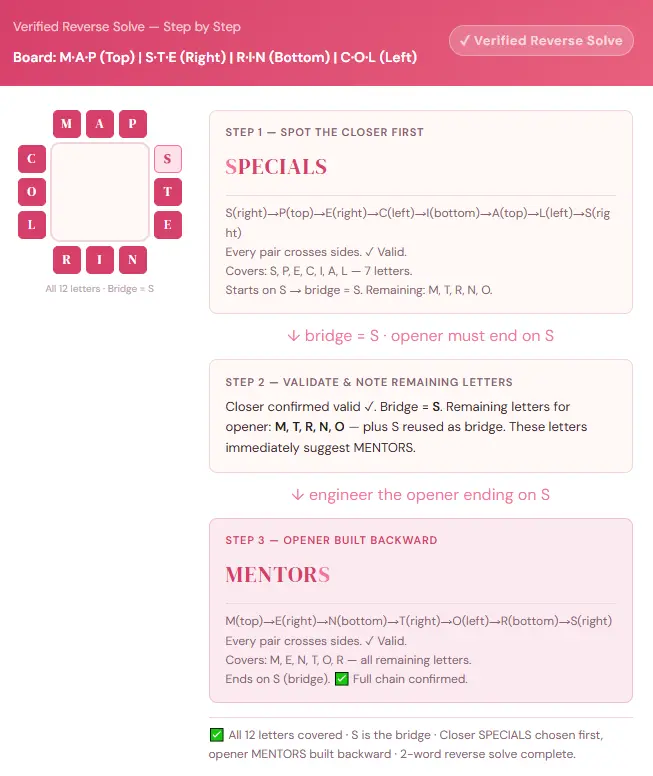
Reverse Solving Applied Example Walk-through
Let’s use the 4-step method on a real puzzle board. Every letter connection below follows the same-side rule correctly.
Why This Solution Works
SPECIAL is probably not the first word you would notice with normal forward solving, because most players start by making short, common words. But when you use this method, you actively search for longer words. Once you spot that SPECIALS works, the remaining letters almost guide you toward MENTORS on their own.
Advanced Move: Use both Forward an
If you want to improve your game, you should not only rely on one method, either the reverse or the forward solving method. You should do a 2 directional research, which means try to build starting words and closing words at the same time, then you will have a larger vocabulary of words in your mind. Choose those words from the vocabulary that share a bridge letter in the middle.
This idea is also used in modern problem-solving research. A 2025 study by Zhang et al. described a method called Reverse Forward Fusion (RFF). It combines backward thinking and forward thinking to solve complex problems. This study found that using both directions together helps you reduce mistakes because each method supports the other.
Common Mistakes to Avoid
Mistake 1
Don’t focus only on the letters themselves. Their positions on the board matter too, because consecutive letters cannot come from the same side.
Mistake 2
Be careful about using common ending letters like S or E too soon. Doing this can reduce your options for the next word.
Mistake 3
Try switching between forward and reverse methods while solving. In many puzzles, using both approaches together leads to better results.
Mistake 4
Don’t rush to enter the first word you see. Spend a few extra seconds planning this will turn a 3-word solve into a 2-word solve.
Why Many Players Use this Method
This method helps you think more clearly about the puzzle. Instead of trying random words, you start with a possible ending word and build around it, which can make the solve feel more organized. Over time, this also helps you notice patterns, bridge letters, and useful word combinations more naturally.
If you get stuck, you can use our free online solver to test your ideas and quickly check if your word chain follows the official NYT Letter Boxed rules.
Final Thoughts
Reverse solving gives you a different way to approach Letter Boxed. Instead of always building from the first word, you begin with a possible ending word and work backward to connect the rest. Start by testing possible ending words, connect them backward, and adjust your chain as needed. On difficult boards, this approach can make the puzzle feel much more manageable.
FAQ